
High School in Ubud: An Alternative Path to 16
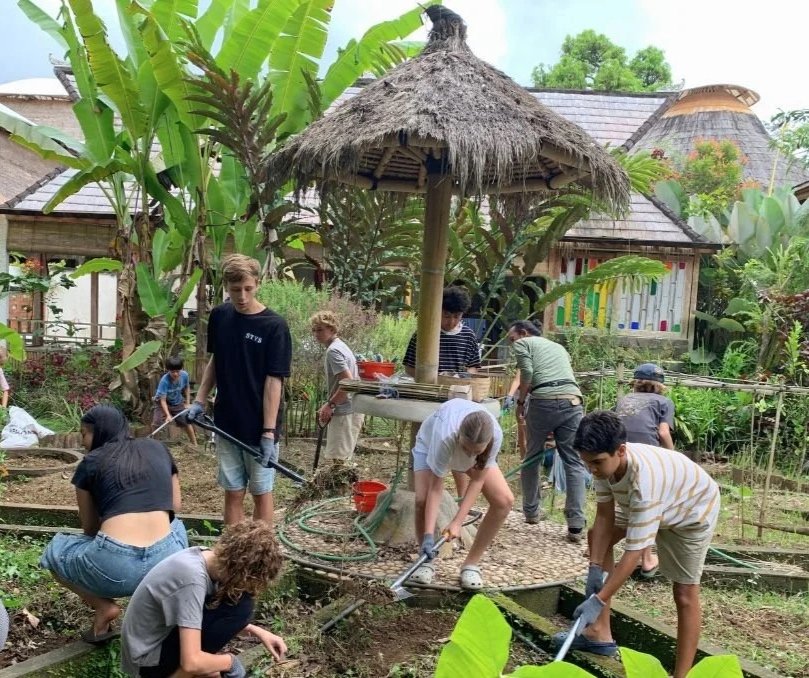
Choosing a high school in Ubud comes with a question that primary-age families don’t face: what about qualifications, and what comes next? It’s the right question to ask and it deserves a fuller answer than a curriculum brochure. Here’s how we think about the teenage years at Future Human School and why we believe the conventional high school model is preparing teens for a world that’s already gone.
The problem with conventional high school
The traditional secondary model is to memorise, test, repeat. It was built for a world of stable career paths. That world is disappearing. One study found 70% of students felt academic education did not adequately prepare them for university or the workforce, and IBM research suggests 61% of the global workforce will need to re-skill within four years. The value of holding information is falling; the value of creatively applying it is rising fast. Teenagers deserve an education built for the world they’ll actually enter.
What the teenage years look like here
Our Core Programme runs to age 16, covering the years families elsewhere would call high school. The structure is deliberately different:
Project pathways that grow with them. Our five pathways - Entrepreneurship, Production, Food, Multiverse Gaming and Personal Exploration repeat annually but increase in complexity, so older students take on genuinely demanding work: business models pitched to real audiences, live events produced end to end, products designed and prototyped for real problems in Bali.
Mentors from the real world. Alongside class mentors, our teens work with a network of mentors from enterprise, sustainability, hospitality, blockchain, finance, permaculture and the arts - adults doing the kind of work our students will one day invent for themselves.
Real deliverables every term. At least two completed projects, a curated portfolio, and a final public presentation. By 16, a Future Human student has a body of real work, not just a transcript.
What about qualifications?
Assessment at Future Human School is portfolio-based. Students build digital and written portfolios reviewed through mentor check-ins, peer feedback and self-evaluation, leading to Da Vinci Qualifications (DVQs) which are awarded on successful completion of two portfolios in a given pathway. Because the Da Vinci Life-Skills curriculum maps to the subjects of the UK national curriculum, students develop the academic foundations that conventional systems test for, they simply evidence them through real work instead of exams.
Every family’s plans beyond 16 are different - university routes, entrepreneurship, creative careers, further study and we work with families individually on the pathway that fits. If you’re weighing this up, come and talk to us; it’s a conversation we have often and gladly.
Teens who’ve just arrived in Bali
Many of our older students join us mid-journey. Families may be relocating, worldschooling or trying Bali for a season. Our one-term minimum enrolment and two-week trial period were designed for exactly this. A term is long enough for a teenager to land, find their people, and finish something they’re proud of. Our Village Days accelerate that: community events, field trips and celebrations that make Ubud feel like home quickly.
Is there an alternative high school in Ubud?
Yes - Future Human School’s Core Programme runs to age 16 in Mas, Ubud, offering a project-based alternative to conventional high school with mentors, portfolios and Da Vinci Qualifications.
What ages does Future Human School accept?
Ages 10–16. Most students join our Bridge Programme first and move up to the Core Programme when they’re skills-ready.
Do students take exams?
No tests or grading. Progress is evidenced through portfolios, mentor reviews and Da Vinci Qualifications (DVQs).
Can a teenager join for one term?
Yes. Minimum enrolment is one full term, with a two-week trial period for new students.